The gear that upgraded my skill and sound: My custom WYN six-string bass
Let’s talk about THAT moment—the moment a piece of gear changes everything. Not just your sound, but your SKILL. Your confidence. Your whole approach to the instrument. For me, that moment came when I got my hands on a custom WYN six-string bass, handcrafted by the late, great Randall ‘Wyn’ Fullmer.
A couple thousand USD back in July 2014, at age 18—that’s not pocket change for a hobbyist teen musician. But let me tell you why it was worth every single dollar and 3 years on a waiting list.
The Beast Itself
-
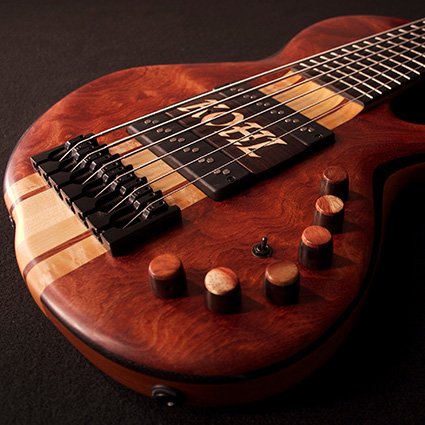
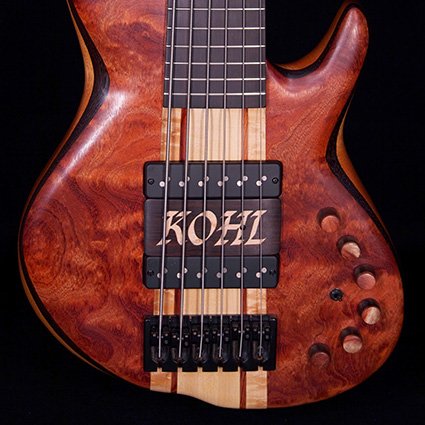
Body: Single-cut Mahogany/Wenge core with a AAAAA Waterfall Bubinga top
-
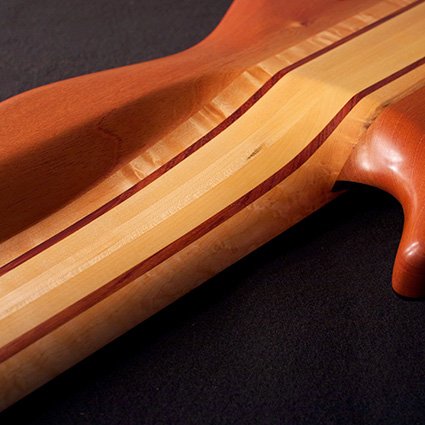
Neck: 35-inch scale, 7-lamination taper-core neck through (Figured Maple, Bubinga Striping, tapered core)
-
Fingerboard: Ebony with Luminlay edge markers—12-18 inch compound radius
-
Electronics: Nordstrand Fat Stack humbuckers + Aguilar OBP-3 preamp (18-volt!)
- 6 pot set up with microswitch for active/passive: volume, pan, push/pull tone, treble, push/pull mid, bass
-
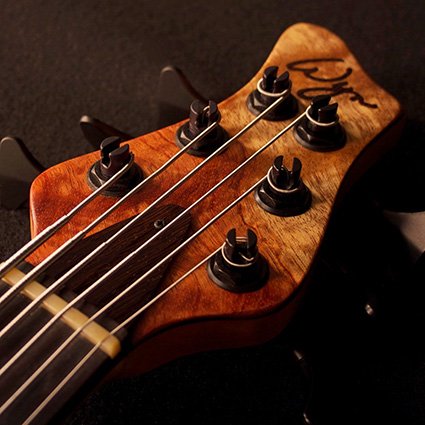
Hardware: Hipshot Ultralite tuners, Hipshot A-style bridge
-
Finish: Hand-rubbed Poly/Oil finish that feels like butter
Completely hand-built in the USA. This thing is a work of ART.
Why It Changed Everything
Firstly, a great man by the name of Keron Thorne once told me, ‘If you want an instrument like that, you should work to have the skills to match it. ‘ He didn’t mean it negatively, and I didn’t take it that way – but I understood clearly it was the equivalent to “The most colourful boots on the football field usually don’t have the skills to match.”
So taking that into consideration, I went on a learning spree to increase my skill as much as possible before I became an embarrassment “wit a bess boots.”And that’s it. That’s literally all it took for me to go up another level in that season. I had to clean up my technique, practise with intention, and LISTEN more carefully to what I was putting out into the world. The bass didn’t just sound better—it made me sound better because it forced me to rise to its level.
Before my Wyn, I played decent gear—a passive 5-string Warwick. I thought at the time, the better the gear, the better sounding the player—that was not true at all. The fact is, what improves the sound and skill of a musician is really the time you take to learn your craft. I do wish I realised that sooner, but everything happens for a reason. However, your tonality and sound change as you mature, and going into a custom instrument a little too soon could either make or break you.”
And no, I don’t regret purchasing my Wyn. It demands excellence. The action is so smooth, the tone so responsive, that every little mistake shows up. Every lazy finger, every rushed note, every half-committed attack—the bass TELLS on you.
The Spiritual Lesson
Here’s the thing about great gear: it’s not a shortcut. It won’t make you good if you’re not willing to put in the work. But if you ARE willing—if you show up, practise with purpose, and respect the craft—great gear will take you places you never thought possible.
That WYN bass taught me that excellence recognises excellence. When you honour the instrument, when you invest in quality, when you refuse to settle for “good enough”—the music responds. The audience responds. YOU respond.
Rest in peace, Randall Fullmer. Thank you for creating instruments that don’t just sound beautiful—they inspire us to BE better.
What’s the one piece of gear that changed your musical journey? Let’s talk about it in the comments.
Sunday-Ready on a Monday-to-Friday Schedule
If you’ve ever walked into Sunday service holding a bass (or guitar, or sticks) in one hand and a half-opened POWERMINT (BY DIANA!) in the other, smiling like you’ve had eight hours of sleep when you’ve actually had “two and a prayer”… yeah. Welcome. You might be a “fake musician” too.
And I don’t mean fake like you can’t play. I mean fake, like you have a calendar invite at 9:00 a.m. on Monday morning, but you’re expected to sound like you actually practise every day for 8 hours. Fake like you own at least one nice piece of gear, but you bought it from your many allowances and first dollars made. “Yuh gigging? Noooooo… But yuh want fancy ting”
That’s me. Trinbagonian-bred, day-job-fed, and worship-ministry-led. Some weeks I’m at work answering emails, with 30+ Google tabs open and another tab open for the set list on YouTube at 1.25x speed, headphones on, just to sink everything in.
People think, “Wow, you must practise every day, right?” Here’s the thing: 60-80% of my practice is listening. I look out for tone, feel, dynamics, and what the other instruments are doing. Life has so much to balance, and if you’re going to do that while being a high-level musician, your ears become one of your most important tools.
Sometimes excellence looks like preparation.
And sometimes excellence looks like adaptation.
What I learned (and what I keep relearning)
- The “fake musician” label is usually just imposter syndrome in a cheap costume.
If you’re practising, serving, showing up, and growing—how are you fake? Listen, half the Psalms were written by a man who had a day job avoiding King Saul.
- Worship isn’t a talent and gear showcase, but skill and gear stewardship is still spiritual.
There’s a difference between chasing the tone like an idol and treating your tools with respect because other people are depending on you.
- God is not shocked by your limitations.
He knows you have a job. The beautiful part is that God doesn’t bench you for being human. Like the cliché saying goes, “God doesn’t call the qualified; He qualifies the called.”
Practical takeaways for the day-job musician
- Get the setlist and build a meditation
Create a playlist and set it on repeat. If you traverse the highway every day like me, you have plenty of time to familiarise yourself—no surprises even if they cut a song.
- Set aside time to learn your craft
Life is busy, but you can’t go forever with just listening as practice. Buy books and watch videos. If you stay with 2000s skills, we’re leaving you behind, Buhhrooooo.
- Build a “bare-minimum rig” plan
Tuner, compressor, backup pre-amp. You don’t need all of this—but at least have a tuner to keep your bass in tune.
- Have a 10-15-minute pre-rehearsal ritual
Tune. Check levels. Pray. “Yuh gotta pray my boi.” Remind yourself: “I’m here to serve, not to prove.”
- Stop comparing your Monday life to someone else’s full-time music life.
Comparison will drain your joy faster than a cheap 9V battery.
I’m still figuring it out. Some weeks I’m on fire—locked in, tone sweet, spirit steady. Other weeks I’m fighting fatigue, wondering why my fingers feel like they ate cement for breakfast. But I’m learning that faithfulness is a sound too. You can hear it in the way someone shows up prepared, humble, and open.
If this hit home—if you’ve ever felt “not legit enough” but still called to play—drop me a message. Tell me what you’re wrestling with: the imposter feeling, the time crunch, the gear stress. I’d genuinely love to hear your story, and we can remind each other we’re not as alone (or as fake) as we think.